
It's a Living
Transfeminine nightmare, the need to fight, and the screaming earth in Aoife Josie Clements' "Persona"

Warning, cowards: spoilers follow…
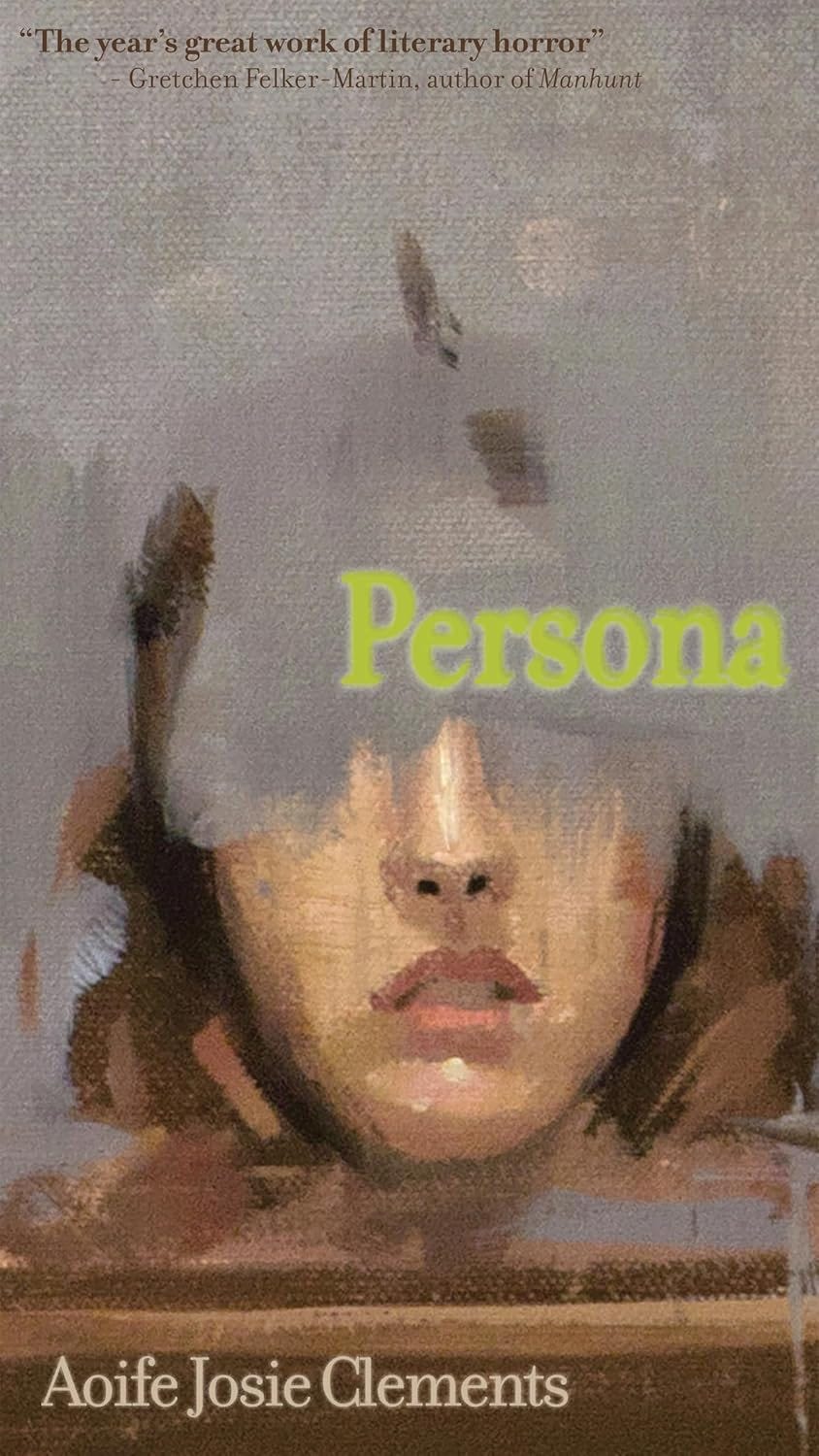
When I introduced myself to Louise Weard at Frameline in Oakland last year, I half-joked that I’m charting the Castration Movie Extended Universe on my blog; I’ve also half-joked on Bluesky that my blog is becoming a Little Puss Press fan club, so of course I had to read and review the only creation that belongs to both: Persona, the debut novel from Aoife Josie Clements, who plays Adeline in Castration Movie and also serves as Weard’s co-host on the Trans Panic movie podcast.
Persona is an intricately constructed and baffling novel whose complex play of perspectives and disorienting shifts in time and place seem only possible in fiction, or at least most possible. I’m kind of stunned that this is Clements’ first novel—it’s working at such a high level in so many respects that I can scarcely imagine what she’ll cook up next, but I’ll be here for it.
Clements shares Weard’s aversion to sanitizing or romanticizing transfeminine life, but pushes even harder, mostly refusing to provide the comic relief that makes the pain of Castration Movie somewhat bearable. I found the novel’s first section, “Sleepwalker,” narrated by an Annie, a trans woman protagonist in her early 20s who lives a zombie-like, shut-in existence in unimaginable squalor, extremely difficult to get through—not because it’s poorly written, but because it requires great concentration and patience to sit with such a miserable, confused person and her slow pace of life. Though she was once attending community college, working as a waitress, and seeing one of her co-workers, Annie now works a mindless remote job filling out surveys for Chariot, a weird marketing company, subsisting (if you can call it that) on a diet of wine, cigarettes, and ramen, and refusing to ever throw out any trash, which has led to her apartment becoming a veritable landfill populated by various vermin with whom she has a somewhat touching relationship:
I’m inclined downwards, my face in the garbage, in the endless empty bottles of wine, cigarette packets, ramen wrappers, staring straight into my friends’ beautiful home, their scattered egg casings, their black-pepper guano, the breeding piles of armoured monarchs, shells layered with microscopic children. I hope to myself that as the days get shorter and my friends dwindle away, they might crawl inside me and make me a world of their own. That I might be able to sustain them better than I’ve sustained myself. To become the landscape, more than just its overseer.
This passage is typical of Clements’ ability to combine genuine tenderness with vomitrocious levels of grotesquerie, and this tenderness carried me through this section of the novel. There’s just something so tragic about this pregnancy fantasy in the midst of a life that isn’t just unbecoming for a young woman, but scarcely even human at all. Our dreams keep us alive, even at the end of our ropes, even as they torture us, because they are made of that torture, and so can never be destroyed by it.
In her free time, Annie hangs out on 4chan-esque forums, where she never outs herself as a trans woman, preferring to remain in the anonymous safety of what she calls the “Default Persona” of these communities, whose social squalor matches the physical squalor in which she lives. That seems to be the entirety of her life, until we learn that she’s been a sleepwalker since childhood, occasionally wandering very far from home. One night, she wakes up on the subway tracks, attacks a transit worker, and wanders home, but she is less troubled by this experience than something she saw the night before: a porn video of a woman who looked exactly like her (more on this in a sec).
I mentioned that the marketing company she works for is weird, but that becomes an understatement as we witness a surreal employee verification ritual that sends an overwhelming volley of flashing lights and ear-splitting sound out of her computer. Although things so far have been heightened from life, the technological impossibility of this verification process is the first sign that we’re dealing with a world that isn’t quite this one, even if it’s still far too close to this one for comfort—or perhaps, we don’t know for sure yet, a manifestation of a sonambulist world between waking and sleep. This uncertainty about what is real and what isn’t within the world of the novel haunts the first section, culminating in the terrifying experience that closes it, which I won’t reveal because I think I’ve been dropping too many spoilers for the narrative work I review, but I’ll say it has to do with her discovery that her cam girl double is named Destiny and lives in the apartment across the courtyard from hers, and it left me totally gobsmacked.
Some temporary relief for the reader comes in the second section when we return roughly to the point in time where the first section started, now proceeding from the perspective of Destiny herself, civilian name Amy—a far more put-together woman who actually has friends, grooms herself, keeps her apartment clean, etc. But this is only to say that her marginality exists in a higher realm of trans girl hell. Each of her advantages over her double has a caveat—she gets help with rent from her mom, but her mom is also super Christian conservative and hasn’t spoken to her since transition. Her friendships ground her somewhat, but she’s only got two and she finds them sort of frustrating, especially the cis girl, Clara, whose semi-delusional self-centeredness and stably tumultuous relationship with her charismatic jackass of a boyfriend, Silas, are hard to take. Amy presumably makes more money than her double, but her work is arguably more degrading than her double’s—she does customer service for Chariot, the weird marketing company, but her inability to help clients forces her to goad them into abusing her so that she can blame them for the company’s failure and send them up the escalation chain. Her other job is being a camgirl, which often forces her, despite her best efforts, to accept far more insidious forms of emotional abuse.
Like her double, she is also haunted—specifically by a monster of an unknown nature that she first perceived in the shifting shadows in her bedroom at night. Long ago, she developed a distinctively obsessional neurotic ritual1 to keep the creature at bay by proving its existence impossible through frenzied mathematical activity regarding the geometry of these shadows, which she scratches into her floor at night. The stratagem works, but—like all obsessional stratagems—never well enough to utterly banish the monster.
Amy’s admission of the monster’s existence to her friends one night leads to a misguided, coke-fueled attempt at a hipster Catholic exorcism and a downward spiral that begins to isolate her in a manner similar to Annie. Although she becomes aware of Annie’s existence before this downward spiral, she doesn’t attempt to make contact until this isolation takes hold, as if drawing closer to her doppelganger’s way of life affords her a less cluttered psychic connection.
There’s a lot of interesting stuff I’m leaving out here, again because I don’t want be so heavy on plot summary, but I do want to observe that the horror here exists on many levels. Yes, there are scary monsters—or are there? At any rate, our twin protagonists think they see scary monsters, but most of the terror in their lives comes from more pedestrian sources—predatory men, economic precarity, mental illness, and the constant paranoia of being trans in a misunderstanding (if not outright hostile) cis world. The book’s two most traumatic scenes, for me, are rape scenes that could absolutely happen in “real life” and unfortunately do all the time. Through Amy, Clements succinctly describes the desperation for affirming connection that can lead trans women to jump recklessly into the arms of whoever will have them:
Honestly, after that client earlier, I don’t want to be alone. No, I need to be around people—I need people to tell me that I’m not just a slut or a sissy or a mommy or a hunk of dead meat. I can’t let myself get lured in again, I can’t let any more of myself be stolen away. I need to be surrounded, to sink into others, and I don’t care who anymore.
Some of my favorite scenes in horror are the downtime scenes, where nothing overtly creepy is happening, but the sense of dread remains, because we know these are simply breaks meant to throw us off guard. In order for horror to function, there must be a sense of ordinary life for the terror to break into, but good horror recognizes this whole duality to be simplistic to the point of illusion—in truth, the terror is already baked into ordinary life. It arrives not as a hostile invader, like in the reactionary imagination, but as the disavowed/repressed/ignored/marginalized aspects of the world—both the human-created world and the existential conditions under which that world is created. Deep horror tells us we contain the monster—we cannot but contain the monster—to fully defeat it would necessarily be to destroy ourselves, to destroy everything. The best we can do is find some way to reestablish the boundaries, physically and psychologically, between aspects of existence that our feeble, mortal minds can only ever find unbearably contradictory. “You cannot see my face,” God tells Moses, “for no one may see me and live.”2
Clements is very good at conveying this sense of dread in the apparent nature of things. No one, even friends, feel safe; the novel’s Vancouver is a soulless, drab, strangely empty place. Like Weard with her notoriously long cuts, Clements leans into every beat of the scenes she chooses to show us, as if we’re right there, living them. This might be tedious in a realist novel, and to be fair it can occasionally be tedious here, but in the narrative’s eerie context, it generally serves to build apprehension and an anxious uncertainty as to the meaning of it all, as well as to underscore the tedium of many trans women’s lives in a society that refuses to let them work many public jobs or even feel welcome in public spaces.
As viscerally gross as some passages of Persona can be, as much as Clements relishes in vividly presenting every uncomfortable detail across all five senses, this is not the horror of deliciously cheap, pulpy thrills—it’s something much harsher and less fun, but all the more cathartic for it: a horror ultimately of despair for abandonment—abandonment by the family, by the economy, by society at large, and finally by one’s own self. Clements recognizes that the problem for us isn’t just transphobia in its most superficial sense as active, conscious bigotry toward trans people, nor even in a more rigorous sense as a systemic tentacle of institutionalized patriarchy, or even in a yet more rigorous sense of institutionalized patriarchy as a weapon of capitalist alienation, which rips all of us away from our proper relation to embodiment and all material existence, leaving us to float, disentangled, hopelessly far from one another, in the dissociated fugue known as ideology. Picking up my thread from earlier: Persona ultimately drives past even these levels of analysis toward a force of pure agitation seemingly buried deep in the heart of reality, more ancient than capitalism, patriarchy, or humanity itself. The studious language of Marxism can’t bring us there, only the language of poetry, storytelling, dreams, and religion, and even they can’t touch it directly. To respect it is wisdom; to try to understand it is madness. Our only defense against it is love, but who’s good at love? Not me, not most of us. Trans people, some of us, anyway, have circled a bit closer to this drain of meaning than the general population, but there are many ways to find yourself in hell, and ours is just one set of them. This hell is our true enemy, and always has been—whatever we fight, if we fight for love, we are fighting it.
Love emerges in the final third of the novel, when Amy finally makes it to Annie’s vile apartment on the other side of the quad, and the two—after a wild scene in which a panicked Annie tries to kill Amy—become fast friends, and maybe a bit more than that—not long after meeting, they’re already fucking, the novel briefly taking a twincest turn. I kind of hated this, but sex is often the currency of relationships between trans women3, so I can’t say it’s indulgent or hard to believe, and it does signal a sort of radical acceptance, especially on the part of Amy, who’s willing to condescend to her double’s disgusting state of self-care to prove her good intentions and desire for a relationship.
The tenderness I described earlier is it its greatest abundance here, and I found it both to be an emotional relief and a narrative surprise—instead of getting on with escalating the terror to its wild climax, we get a little kiki testifying to the awesome power of trans sisterhood, complete with a trip to the local diner for a couple of lumberjack specials. The arguments and conversations between Amy and Annie in this section are fascinating, functioning at times like Socratic dialogues on the vexing questions that face many trans women, most of which boil down to the conflict between assimilationism and separatism. “Just because I don’t put a ton of effort into how I look,” Annie says at one point, “doesn’t mean I’m not a woman, not any less than you are.” Amy’s response is worth quoting in full:
No, I get that. And I’m sorry, I really don’t mean to make a bad situation worse for you. But I just ... What good are you doing for yourself by being trans without being? If, like, the goal of transition is to shift the way you’re perceived in society, isn’t not letting yourself be perceived kind of admitting that you don’t really want that? Like, are you sure this is working for you? And, like, it’s a lot easier to get somebody to get rid of themselves than it is to actually take them out. No, seriously! You know, go ahead, live your degenerate lifestyle, just do it in secret, drive yourself further and further into the margins until you may as well not exist. So why not just take the stares, take the passive aggression, thank god you were born white and with a little money, you’re not in any real danger, just live your life. Even if people were out to get you, wouldn’t you want to die with some self-respect?
Loyal readers of Words + Time will be familiar with this line of argument. It could be spoken to Jennifer Coates, or the spiritually comatose members of the Polygon cult in Castration Movie’s second part. I’ve already said a lot about this topic in those reviews, but I want to add here that courage is a virtue trans women sometimes either seem to have in impressive abundance (“stunning and brave”) or lack entirely (“I’m NGMI”), the latter group cooking up infinite sob-story excuses to justify a petulant refusal to do anything but exist. The legendary tweet sets the bar way too low:
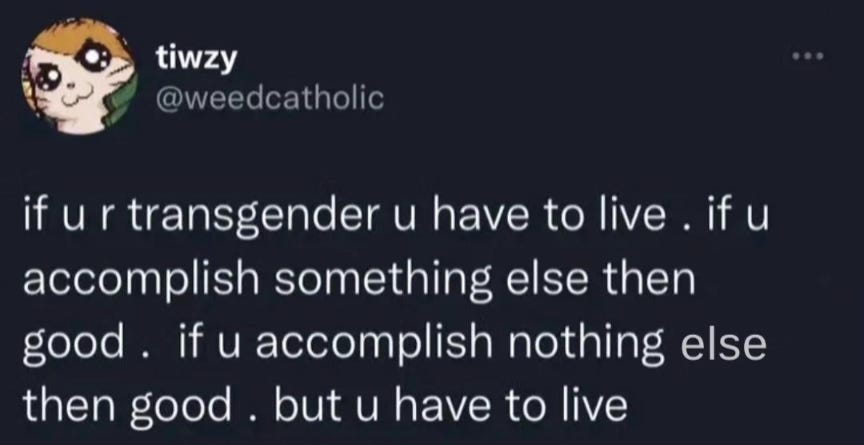
Why is it always the cartoon animal avatar kids? No tiwzy, sorry but merely living won’t keep you alive. Maybe for a while to get your bearings, sure, but eventually you have to fight. The fight can take many forms but you have to fight, and you have to fight because if you cannot fight you cannot live in a way that means anything. To be able to hide from the world and avoid all but the most minimal work is a corrupting, self-centered privilege, but it’s hard to notice that when the spoils of such a life are abjection, loneliness, unemployment, etc. Annie loves her wretched safety like Gollum loves that ring, and even though she consents to run away with Amy and start a new life, it causes her a lot of pain to clean her apartment. Perhaps it’s only a rapidly-developed, needy dependence on the more mature Amy that gives her the strength to do this, in which case she trades one kind of selfishness for another, but it’s a trade up, a move into some kind of relationship rather than a refusal to relate at all. This is what fighting might look like for someone so morally weakened, but it’s still fighting.
Amy’s stunning bravery also has its drawbacks. Convinced that the twins’ mutual employment at Chariot must mean something, she insists that they go and visit the corporate HQ before they set off for their new life, leading to the novel’s dazzlingly bizarre climax, a feat of visceral sensory imagination in which Amy risks everything to find out where she and Annie came from—and what she discovers, deep inside the earth’s crust, is weird beyond words (despite words being used to show it to us), and explained just enough to prevent you from feeling utterly cheated as a reader hungry for closure, but left with an paradoxically satisfying ache to know more than you ever can.
I really don’t want to completely spoil this ending, and I also don’t think I understand it enough to analyze it thoroughly, but I’ll just say it reminded me of the mythic domain of Cthelll in the “theory fiction” lore of the Cybernetic Culture Research Unit, a rogue offshoot of the philosophy department at the University of Warwick that was active during the 90s and 2000s. One of the group’s many collective personae, D.C. Barker, has this to say of Cthelll:
Trauma is a body. Ultimately – at its pole of maximum disequilibrium – it’s an iron thing. At MVU they call it Cthelll: the interior third of terrestrial mass, semifluid metallic ocean, megamolecule, and pressure-cooker beyond imagination. It’s hotter than the surface off the sun down there, three thousand clicks below the crust, and all that thermic energy is sheer impersonal nonsubjective memory of the outside […]
Cthelll is the terrestrial inner nightmare, nocturnal ocean, Xanadu: the anorganic metal-body trauma-howl of the earth, cross-hatched by intensities, traversed by thermic waves and currents, deranged particles, ionic strippings and gluttings, gravitational deep-sensitivities transduced into nonlocal electromesh, and feeding vulcanism … that’s why plutonic science slides continuously into schizophrenic delirium.
“Sheer impersonal nonsubjective memory of the outside” is maybe the key phrase here, for my purposes at least. “The outside” refers to Kant’s noumena, the world-in-itself that humans can never perceive as it is, only through the dark glass of our five paltry senses. Nonetheless (this is me now, not Kant), a part of us longs to know it, to unite with it: “That place beyond where your ability to, like, express what you’re feeling in words ends and where the gut kicks in,” says Silas, “that kinda instinctual sense that you gotta do what you gotta do at the end of the day.” The goal of the CCRU was to usher the insensible but very real forces of the outside in to upset the prevailing order of things, and they developed an entire system of cyberpunk witchcraft to accomplish this, but they also (controversially for leftists) venerated capitalism as the greater vehicle for these aims. Likewise in Persona, we learn that Chariot has discovered something much like Cthelll and is attempting to exploit it for profit, but they, at least from what Annie can hear of an executive’s phone call, don’t seem to understand it very well at all, which tracks.
It is here that we find the deepest sense of body horror: to be a material being who remembers is to inherit the overwhelming trauma of matter’s constant flux, all the way back to the big bang—and perhaps even further than that—and crucially, to be able to articulate it. Body horror is the most immediate level of cosmic horror, the pop physicist’s wondrous statement that “we are all stardust” rendered in its most terrifying form. In humans, the impersonal and nonsubjective become (inter)personal and (inter)subjective. We bear the trauma of the whole universe. It’s an attractive account of the problem of evil, at least human evil: motion, change, and time are pain, and they are our true parents. Pain is what we are. No wonder we’re so fucked up. From the same essay linked above, attributed to one “Maya B. Kronic”:
Trauma is not personal, and the time of the earth is recorded, accreted, knotted up inside us. All human experience is an encrypted message from Cthelll to the cosmos, the scream of the earth.
There is a beauty to this pain. Amy’s encounter with the infernal machine destroys her, but in a moment of blissful reunion with her true family. “No one may see me and live,” but love remains, in all its mystery, in the inarticulable realm beyond and before personality—our truest and deepest memory.
One of the two primary forms of neurosis in Lacanian psychoanalytic theory, obsessionality, which corresponds only superficially to the DSM-V diagnosis of obsessive-compulsive disorder, frequently involves the magical use of thought and behaviors to keep unwanted emotions (typically related to the idea of one’s self as a vector of harm) at a distance, as well as an anxious desire to neutralize the subjectivity of other people, out of a sort of “this town ain’t big enough for the two of us” logic. Because humans are profoundly intersubjective beings, the refusal to acknowledge the other invariably leads to a dissociation from the self and the body, returning the subject to the obsessional’s fundamental underlying question: “Am I alive or dead?” Obsessionality is the more common neurotic structure for people socialized male as children, including, I’d contend, most trans women (albeit in a distinctly female form), and one can find many other obsessional themes in Clements’ portrayals of Amy and Annie—especially in the way Annie sort of buries herself alive in her apartment (and also, more literally, in a hole in the ground outside of it). There’s a rich possible reading of Persona as an obsessional horror novel, but I’ve chosen to explore a different set of themes in this essay, for fear of getting too Lacanian for anyone’s good.
Exodus 33:20
Auto_Anon touches on this in a recent essay.
I've been on the lookout for trans fiction that doesn't read as pure misery porn (Nevada and Detransition baby were both too much for me) so this sounds like a much happier medium for my mental state. Cool review and well earned dunk on the animal avatar truthism posters.
Yesssssss